Port Finance to List on AscendEX
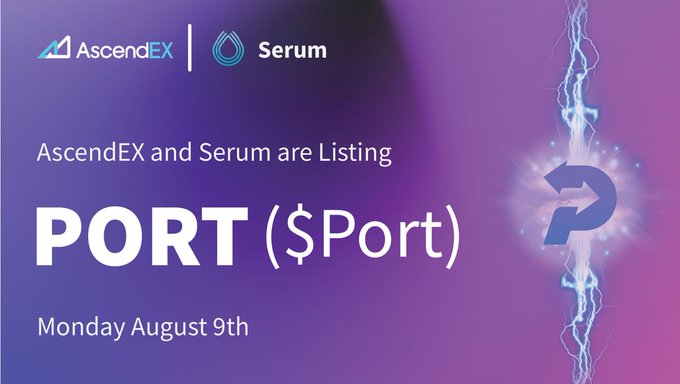
AscendEX, a global cryptocurrency financial platform with a comprehensive product suite, is excited to announce the Port Finance token (PORT) under the pair USDT/PORT on Aug 9 at 2 p.m. UTC.
Port Finance is a money-market, non-custodial liquidity protocol on Solana, aims to provide a comprehensive suite of lending products, including variable-rate lending, fixed-rate lending, and interest rate swap. Their idea is to take advantage of the growth in size and capability of the Solana network.
Port Finance brings interest rate markets to the Solana ecosystem. It leverages the Solana blockchain’s high speed and low latency with a product suite that includes variable rate lending, fixed-rate lending, and interest rate swaps. Port Finance takes a three-step approach; they provide a baseline lending protocol similar to Compound and Aave on Ethereum. Secondly, they launch a fixed rate lending protocol that utilizes the Serum order book. And finally, they build out an interest rate swap market that uses the Serum order book.
Their focus is on leveraging the technological advancements of the Solana blockchain and the Serum ecosystem to bring lending products to the market that are difficult to implement on Ethereum. By utilizing the Solana blockchain’s low latency network, Port Finance will allow the user to borrow more with the same amount of collateral compared to Ethereum products such as Compound and Aave.
About AscendEX
AscendEX (formerly BitMax) is a global cryptocurrency financial platform with a comprehensive product suite including spot, margin, and futures trading, wallet services, and staking support for over 150 blockchain projects such as bitcoin, ether, and ripple. Launched in 2018, AscendEX services over 1 million retail and institutional clients globally with a highly liquid trading platform and secure custody solutions.
About Port Finance
Port Finance is a money-market, non-custodial liquidity protocol on Solana. They aim to provide a comprehensive suite of lending products, including variable-rate lending, fixed-rate lending, and interest rate swap.
▶️ HEADLINES