Crypto as a Cognitive Labor Market
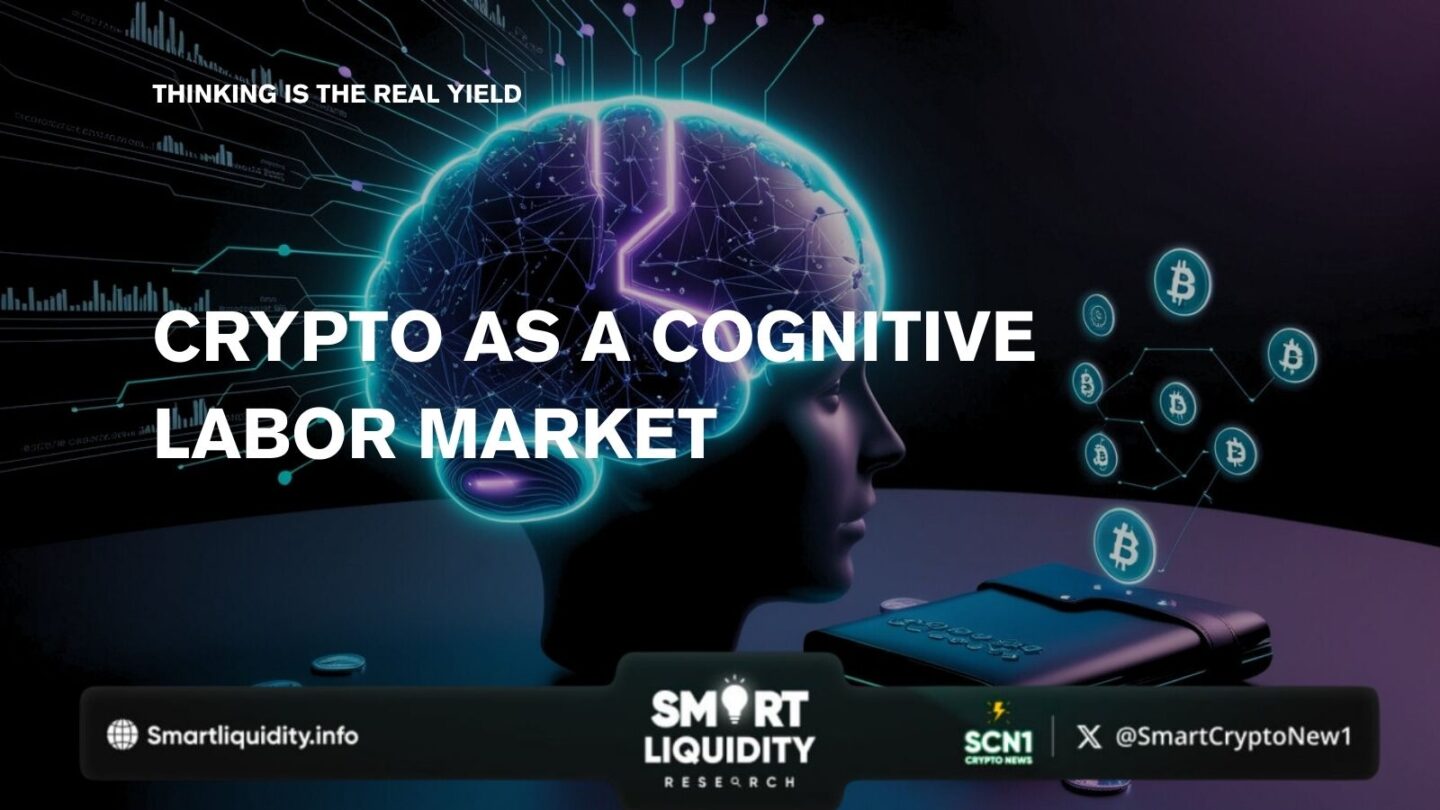
Crypto keeps pretending it’s only about money. It’s not.
It’s about thinking.
Every day, millions of people deploy cognitive labor into crypto: analyzing charts, modeling risk, reasoning through governance proposals, hunting arbitrage, auditing smart contracts, forecasting narratives, and deciding when not to act. This is mental work. Real work. Yet almost all of it goes unpaid, unaccounted for, and unrecognized.
Crypto has built an open financial system—but accidentally created an invisible cognitive labor market.
Wallets Are Résumés (We Just Don’t Treat Them Like That)
In Web2, your résumé lists skills you claim to have. In crypto, your wallet shows skills you’ve proven.
A transaction history can reveal:
- Risk tolerance and timing under pressure
- Strategic capital allocation
- Long-term conviction vs. short-term speculation
- Interaction with complex protocols (bridges, derivatives, MEV-aware actions)
This isn’t just financial behavior. It’s applied reasoning under uncertainty.
Your wallet is a public record of how you think—just not labeled as such.
If crypto were honest, wallets wouldn’t just be addresses. They’d be cognitive portfolios.
Transaction Histories as Proof-of-Work for Thinking
Bitcoin proved that work could be verified without trust.
Crypto now accidentally verifies thinking without realizing it.
Every decision on-chain is a micro proof-of-work:
- “I assessed this protocol as safe enough.”
- “I believed this governance proposal would pass.”
- “I anticipated this market reaction.”
- “I chose patience over panic.”
Unlike traditional jobs, no manager is grading you. The chain records outcomes. Brutally. Permanently. Meritocracy with receipts.
And yet—we don’t price this labor. We only reward capital, not cognition.
The Missing Market: Mental Capital
Crypto is obsessed with financial capital efficiency:
- Yield curves
- Capital velocity
- Liquidity incentives
But mental capital—the ability to reason well in adversarial, high-noise environments—is arguably scarcer.
Good thinkers outperform big wallets over time.
Great analysts move markets before money does.
Narrative builders create value before code ships.
Still, the system mostly says: bring money or leave.
That’s backward.
You’re Already Working for Crypto (For Free)
Here’s the uncomfortable truth:
If you’ve ever researched a protocol, debated tokenomics, stress-tested an assumption, or educated others, you’ve done unpaid labor that increased the ecosystem’s intelligence.
Crypto runs on this free cognitive surplus:
- Discord analysts
- Twitter threads
- DAO forum debates
- Anonymous researchers
- Pseudonymous forecasters
They generate alpha, safety, and clarity—without guaranteed compensation.
Your brain already works for crypto.
You just aren’t paid for it (yet).
What Comes Next
The next evolution isn’t another L2. It’s recognition.
Expect systems where:
- Wallet histories become reputation-weighted credentials
- Cognitive contributions (analysis, prediction, governance) are priced
- Mental capital earns yield, not just attention
- Proof-of-thought matters as much as proof-of-stake
Crypto won’t just be a financial market.
It will be a labor market for thinking.
And when that clicks, the smartest asset you own won’t be your tokens.
It’ll be your mind.