DeFi Is Built on Infinite Loops—Until One Breaks
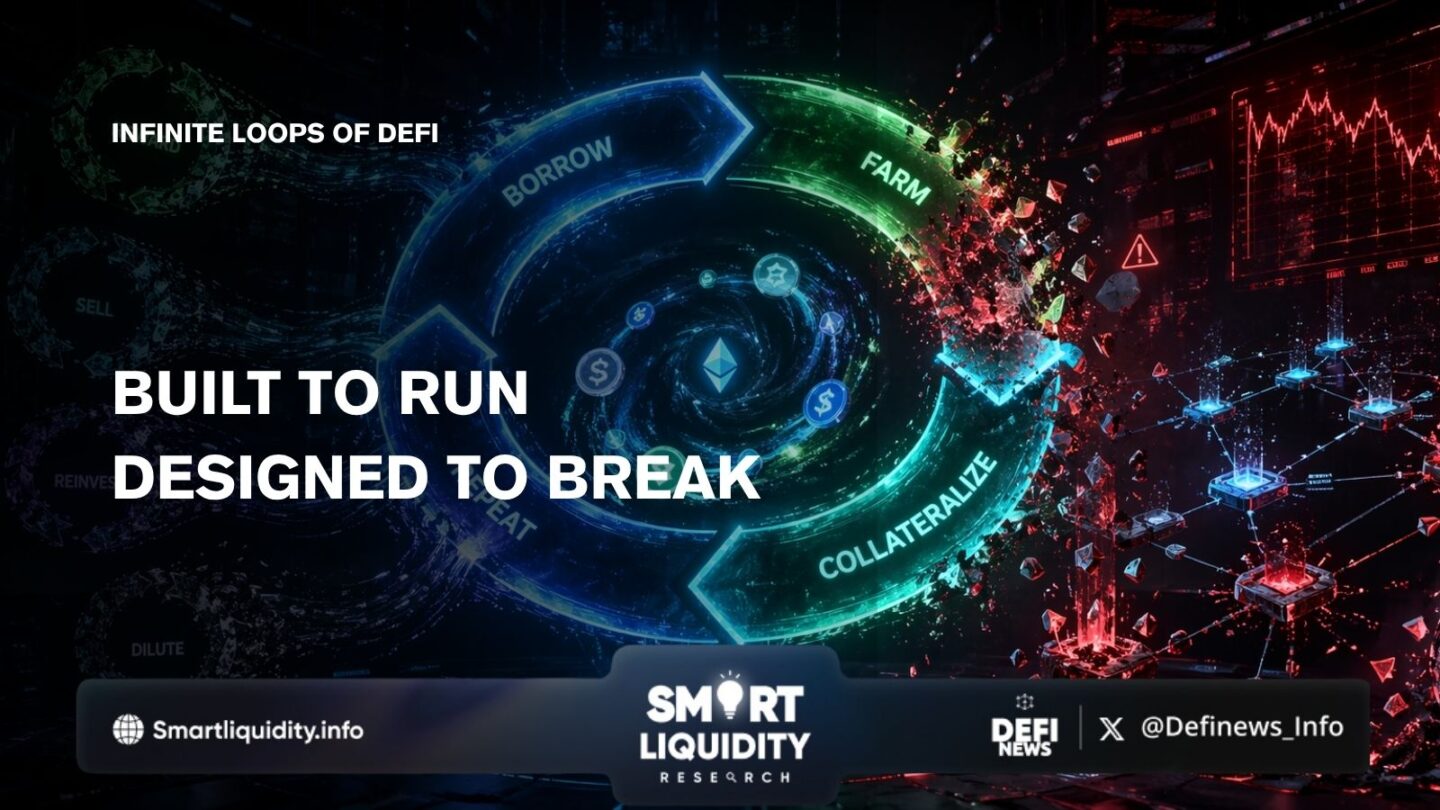
Decentralized Finance (DeFi) has redefined how capital moves, grows, and interacts in digital markets. At its core, however, DeFi is not powered by static value creation but by recursive financial loops—self-reinforcing cycles designed to maximize capital efficiency. These loops enable users to extract yield, amplify exposure, and optimize liquidity. Yet, the same mechanisms that drive growth also introduce systemic fragility.
The Architecture of DeFi Loops
A defining feature of DeFi is composability—protocols stacking on top of one another like financial building blocks. This has given rise to highly efficient, but deeply interdependent, cycles:
- Borrow → Farm → Collateralize → Repeat
Users deposit assets as collateral, borrow against them, deploy the borrowed funds into yield-generating strategies, and then re-collateralize the resulting assets to repeat the process. This loop increases capital utilization, often severalfold. - Reward → Sell → Reinvest → Dilute
Incentive mechanisms distribute governance tokens or rewards, which are frequently sold for profit or reinvested into the same system. While this drives short-term participation, it also creates persistent sell pressure and token dilution.
These loops are not incidental—they are foundational. They sustain liquidity, attract users, and maintain competitive yields across protocols.
The Illusion of Perpetual Stability
Under favorable conditions—rising asset prices, stable liquidity, and consistent demand—these loops can appear self-sustaining. Yield compounds, collateral values rise, and liquidation risks remain low. This creates an environment where:
- Leverage feels manageable
- Rewards appear predictable
- Systemic risks are underestimated
However, this stability is often reflexive rather than fundamental. It depends on continuous participation and favorable market dynamics rather than intrinsic value generation.
Breaking the Loop
The inherent risk in recursive systems is that they rely on uninterrupted cycles. When a single component falters, the effects can cascade rapidly:
- A drop in collateral value triggers liquidations
- Liquidity exits reduce yield opportunities
- Token prices decline due to sustained selling
- Confidence erodes, accelerating capital flight
What once functioned as a growth engine becomes a feedback loop in reverse—a contraction spiral.
This is not merely theoretical. DeFi history has repeatedly demonstrated how quickly interconnected systems can unwind when assumptions fail.
Systemic Fragility and Reflexivity
DeFi loops exhibit strong reflexivity: system health depends on user behavior, while user behavior depends on perceived system health. This creates a delicate balance where:
- Growth reinforces confidence
- Confidence reinforces growth
- But doubt can trigger a rapid collapse
Unlike traditional finance, where circuit breakers and centralized oversight can intervene, DeFi operates in a largely permissionless environment. As a result, loop failures tend to be abrupt and unforgiving.
Toward More Resilient Systems
Recognizing the limitations of infinite loops is critical for the maturation of DeFi. Sustainable systems may require:
- Reduced reliance on token emissions as primary incentives
- Greater emphasis on real yield (e.g., fees, productive activity)
- Improved risk management and collateral standards
- Mechanisms that dampen, rather than amplify, volatility
While loops will likely remain a core feature of DeFi, their design must evolve to prioritize durability over short-term growth.
Closing Remarks
DeFi’s innovation lies in its ability to turn capital into a dynamic, self-reinforcing system. Infinite loops—of borrowing, farming, and reinvesting—have unlocked unprecedented efficiency. But they also embed structural risks that cannot be ignored.
These systems work—until they don’t.
Understanding where the loops begin, how they sustain themselves, and what causes them to break is essential for anyone navigating the DeFi landscape. In a system built on cycles, resilience depends not on how fast the loop spins, but on how well it holds under stress.
REQUEST AN ARTICLE