DeFi and the Rebuilding of Finance
Introduction
Reimagining financial primitives in a trust-minimized world
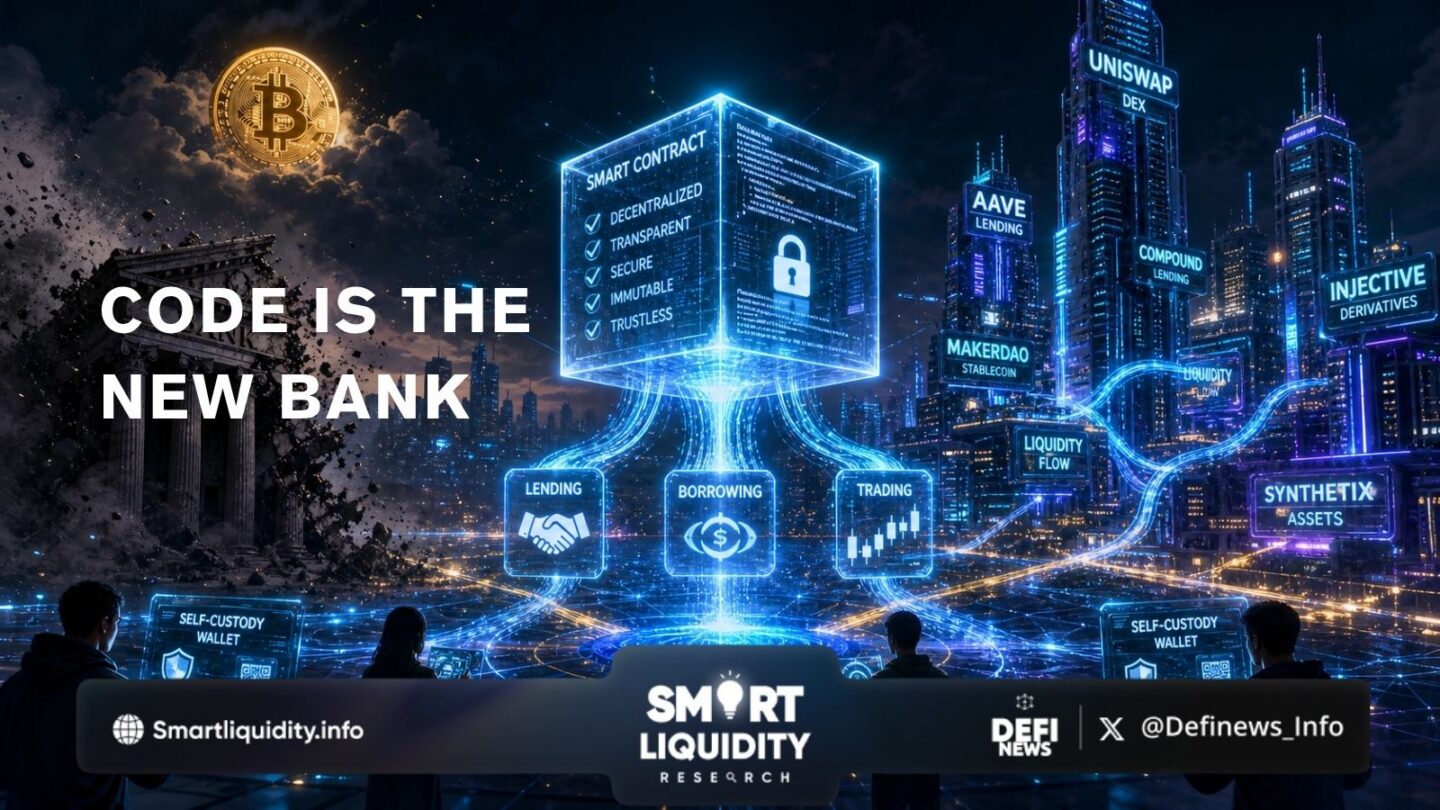
Decentralized Finance (DeFi) represents one of the most ambitious attempts to reconstruct the global financial system from the ground up. Built primarily on blockchain networks like Ethereum, DeFi replaces centralized intermediaries—banks, brokers, and clearinghouses—with transparent, automated protocols governed by code.
Where traditional finance relies on institutions to enforce trust, DeFi relies on cryptography, consensus mechanisms, and smart contracts. The result is a parallel financial system that is open, programmable, and globally accessible—yet not without its own structural vulnerabilities.
Replacing Traditional Banking Primitives
At its core, finance is built on a few fundamental primitives: custody, lending, borrowing, trading, and settlement. DeFi reconstructs each of these using blockchain-based infrastructure.
Custody Without Banks
In traditional systems, financial institutions hold and manage assets on behalf of users. DeFi replaces this with self-custody through digital wallets. Users maintain direct control over their funds, secured by private keys rather than institutional guarantees.
This shift eliminates counterparty risk tied to custodians—but introduces a new responsibility: the user becomes their own bank. There is no recovery mechanism for lost keys, no customer support desk, and no safety net.
Programmable Lending and Borrowing
DeFi lending protocols, inspired by early innovations in the ecosystem, allow users to lend assets and earn interest, or borrow against collateral, without credit checks or intermediaries.
Smart contracts automatically enforce loan conditions:
- Collateral is locked on-chain
- Interest rates adjust dynamically based on supply and demand
- Liquidations occur instantly when collateral thresholds are breached
This system replaces the bureaucratic processes of traditional banking with algorithmic efficiency—but also removes human discretion, often leading to abrupt and unforgiving outcomes during volatility.
Decentralized Exchanges (DEXs)
Instead of relying on centralized exchanges to match buyers and sellers, DeFi uses liquidity pools governed by automated market makers (AMMs). These pools allow users to trade assets directly from their wallets.
Liquidity providers supply capital to these pools and earn fees from trading activity, effectively becoming micro-market makers. This democratizes participation in financial markets, but also exposes participants to risks such as impermanent loss and volatile fee structures.
Yield Generation Without Intermediaries
One of DeFi’s defining innovations is the ability to generate yield without traditional financial intermediaries. Yield farming, staking, and liquidity provision enable users to earn returns by actively participating in protocol ecosystems.
Unlike savings accounts in traditional banks—where interest rates are centrally determined—DeFi yields are:
- Market-driven
- Highly dynamic
- Often incentivized by token emissions
This creates opportunities for significantly higher returns, but also introduces complexity and instability. Yield is not generated solely by underlying economic productivity; in many cases, it is subsidized by speculative incentives, raising questions about sustainability.
Risks in a Permissionless System
Despite its promise, DeFi is not a frictionless utopia. Removing intermediaries does not eliminate risk—it redistributes and, in some cases, amplifies it.
Smart Contract Failure
Smart contracts are immutable once deployed. A flaw in the code can lead to catastrophic losses, as exploits can drain funds within seconds. Unlike traditional systems, there is no central authority to reverse transactions or compensate users.
Audits and formal verification reduce risk but cannot guarantee safety. The system’s integrity ultimately depends on the quality of its code.
Liquidity Crises
DeFi markets rely heavily on liquidity pools. In times of stress, liquidity can evaporate rapidly, leading to cascading liquidations and extreme price slippage.
Because many protocols are interconnected, a failure in one can trigger systemic effects across the ecosystem—mirroring, and sometimes exceeding, the contagion risks seen in traditional finance.
Human Greed and Speculation
While DeFi is powered by code, it is driven by human behavior. Speculative mania, herd mentality, and short-term profit seeking often dominate decision-making.
This has led to:
- Rug pulls and fraudulent projects
- Unsustainable yield schemes
- Rapid boom-and-bust cycles
The absence of regulation allows for innovation—but also creates an environment where bad actors can operate with minimal resistance.
Bitcoin: A Store of Value, Not a Financial System
No discussion of DeFi is complete without addressing Bitcoin, the first and most recognized blockchain asset.
Bitcoin was designed as a decentralized store of value and a peer-to-peer payment system. Its architecture prioritizes security, simplicity, and immutability over programmability. As a result, it does not natively support the complex smart contracts required for DeFi applications.
This creates a fundamental distinction:
- Bitcoin functions as “digital gold.”
- DeFi operates as a programmable financial layer.
Efforts have been made to bridge Bitcoin into DeFi ecosystems through wrapped assets and sidechains, but these solutions often introduce additional trust assumptions—ironically reintroducing intermediaries that DeFi seeks to eliminate.
In this sense, Bitcoin sits adjacent to DeFi rather than fully within it: a foundational asset that provides value storage, but not the infrastructure for financial experimentation.
Conclusion
DeFi represents a radical rethinking of financial systems—one that replaces institutional trust with transparent, autonomous code. It reconstructs lending, borrowing, and trading into permissionless protocols that operate without centralized control.
Yet this transformation comes with trade-offs. Efficiency replaces oversight, automation replaces discretion, and accessibility replaces protection. The risks—technical, systemic, and behavioral—are not eliminated but reshaped.
The future of finance may not lie in the complete replacement of traditional systems, but in the convergence of both models: combining the resilience and innovation of DeFi with the safeguards and stability of established institutions.
For now, DeFi remains an evolving experiment—one that is simultaneously rebuilding finance and stress-testing the limits of decentralization.