Why AI Agents Need Stablecoins
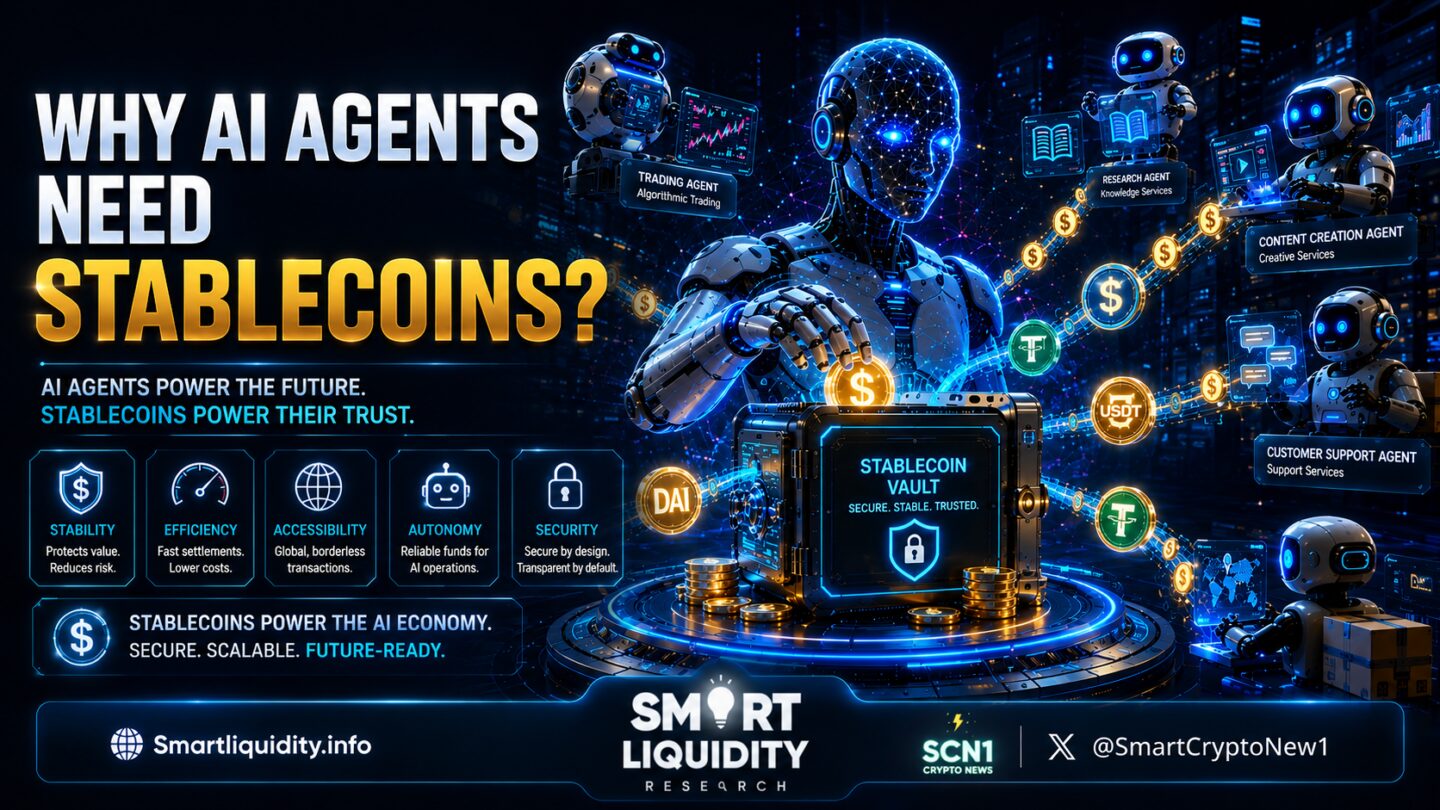
Artificial intelligence is moving beyond chatbots and copilots. The next generation of AI systems is increasingly capable of acting on behalf of users—searching for information, purchasing services, managing workflows, executing trades, interacting with applications, and coordinating with other software agents.
But there is one major capability AI agents still need to operate effectively in an increasingly autonomous digital economy: money they can use programmatically.
This is where stablecoins could become especially important.
Unlike traditional bank-based payments, stablecoins can move value directly across blockchain networks, operate 24/7, and be integrated into smart contracts and software applications. For AI agents that need to make frequent, automated, and machine-to-machine payments, these characteristics could make stablecoins a natural financial layer.
AI Agents Are Becoming Economic Actors
An AI agent is more than a system that generates an answer. An agent can be designed to perceive information, make decisions, use tools, and execute actions with limited human intervention.
Imagine an AI agent managing an online business.
It could:
- Purchase computing resources when demand increases.
- Pay another AI agent for specialized data.
- Subscribe to an API.
- Purchase advertising services.
- Pay for storage.
- Execute transactions according to predefined rules.
- Receive payments for completing tasks.
- Exchange one digital asset for another.
Each of these activities requires some form of payment.
If AI agents are expected to operate continuously and independently, relying exclusively on traditional payment systems could introduce significant friction.
Bank accounts often require identity verification, geographic availability, banking relationships, business accounts, payment processors, and human-controlled authentication. Those requirements make sense for people and companies, but they can become cumbersome when the payer itself is autonomous software.
Stablecoins offer a different model.
Stablecoins Give AI Agents Programmable Money
The defining feature of a stablecoin is relatively simple: it is a blockchain-based token designed to maintain a stable value, typically relative to a fiat currency such as the U.S. dollar.
For AI agents, the important part isn’t simply the stability.
It is the combination of stability + programmability + global accessibility.
An AI agent can interact with blockchain infrastructure through software. It can hold digital assets in a wallet, check balances, sign transactions according to its permissions, and interact with smart contracts.
That creates the possibility of a machine-controlled financial account.
Instead of an AI agent saying:
“I need a human to approve this $5 payment.”
the system could be designed to automatically execute the payment when predefined conditions are satisfied.
For example, an AI research agent might have a wallet funded with $100 in stablecoins. It could spend a maximum of $2 per API request, $10 per day on data, and $25 per week on specialized services.
These rules can potentially be enforced through smart contracts, wallet permissions, spending limits, and other programmable controls.
Machine-to-Machine Payments
One of the most interesting applications is machine-to-machine commerce.
The internet was originally designed primarily for humans to communicate and transact. AI agents introduce a new possibility: software communicating and transacting with other software.
Consider a network of specialized agents.
One agent performs market research.
Another analyzes financial data.
A third provides computational resources.
A fourth verifies information.
Instead of every transaction passing through a human-controlled billing process, agents could pay one another directly.
For example:
Agent A → pays stablecoins → Agent B → receives data → Agent A
The payment could happen automatically based on predefined conditions.
At large scale, this could create a new digital economy where tiny transactions occur continuously between autonomous software systems.
Why Stablecoins Instead of Volatile Crypto?
AI agents need predictable economics.
Imagine an autonomous agent with a budget of $1,000.
If it holds a highly volatile cryptocurrency, the purchasing power of that budget could change dramatically. A service that costs $20 today might effectively consume substantially more or less of the agent’s available capital tomorrow.
Stablecoins can reduce that problem.
A dollar-denominated stablecoin gives the agent a relatively predictable unit for budgeting, accounting, pricing, and payments.
That matters particularly for:
- API usage
- Cloud computing
- Data purchases
- Subscription services
- Digital labor
- Advertising
- Automated commerce
- Agent-to-agent payments
If AI agents are going to participate in real economic activity, predictability may be more valuable than speculation.
Stablecoins Could Enable Micropayments
Traditional payment infrastructure isn’t always optimized for extremely small, frequent transactions.
Blockchain-based stablecoin payments could potentially support smaller transactions with automated settlement, depending on the network and its transaction costs.
This opens the door to interesting business models.
An AI agent might pay:
- $0.01 for a data point
- $0.05 for a computation
- $0.10 for an API request
- $0.50 for a specialized analysis
- $2 for a completed task
Instead of purchasing a large subscription, an agent could potentially pay precisely for what it consumes.
This could transform the economics of digital services.
Rather than humans subscribing to software, software could dynamically purchase services from other software.
Stablecoins Could Give Agents Global Payment Rails
Another major advantage is geographic reach.
Traditional financial infrastructure remains fragmented across countries, banks, payment networks, currencies, and regulatory systems.
Stablecoins operate on blockchain networks that can be accessed globally.
For AI agents operating across borders, this could simplify settlement.
An AI company in one country could operate an agent that purchases computing services from another provider, while a third-party agent supplies specialized data from another region.
Stablecoins could provide a common settlement asset across these interactions.
The AI agent doesn’t necessarily need to understand banking systems in every country.
It simply needs to understand the payment rules of the digital network it operates on.
AI Agents Could Become Their Own Economic Identities
This leads to an even bigger concept.
Today, an AI agent usually operates under the identity and financial accounts of a person or company.
In the future, agents could potentially have their own cryptographic identities, wallets, permissions, and transaction histories.
That does not necessarily mean an AI becomes a legal person.
Instead, it could mean that an agent becomes a distinct economic software entity.
For example:
Agent ID: ResearchAgent-204
Wallet: Dedicated blockchain address
Budget: $500/month
Spending limit: $20/transaction
Allowed services: Data + computing
Approval threshold: Human authorization above $20
This structure could make autonomous systems easier to monitor and control.
Blockchain transactions could also provide an auditable record of what the agent spent and where the funds went.
The Combination of AI + Smart Contracts Is Powerful
AI agents are good at making decisions.
Blockchains and smart contracts are good at executing deterministic rules.
Stablecoins connect the two through money.
That creates a potentially powerful architecture:
AI → Decision
Smart Contract → Rules
Stablecoin → Value
Blockchain → Settlement
Consider an autonomous procurement agent.
The AI determines that a company needs additional computing capacity. It compares providers, selects one based on price and performance, and initiates the purchase.
A smart contract could enforce the agreed conditions.
The stablecoin payment could be released when those conditions are satisfied.
The blockchain records the transaction.
In this model, AI handles the intelligence while blockchain handles coordination, ownership, and settlement.
The Challenges Are Just as Important
Stablecoins are not a magic solution.
AI agents managing money introduce serious risks.
Security
If an AI-controlled wallet is compromised, attackers could potentially gain access to its funds.
Agents therefore need strong wallet security, permission systems, spending limits, and transaction controls.
Hallucinations and Bad Decisions
An AI agent can make incorrect decisions.
If an agent is allowed to spend money autonomously, an incorrect assumption could become a financial loss.
This makes human oversight and programmable constraints extremely important.
Smart Contract Risk
Smart contracts can contain vulnerabilities.
An AI agent interacting with poorly designed contracts could potentially expose its funds to unnecessary risks.
Regulatory Uncertainty
Stablecoins operate within an evolving regulatory environment.
Different jurisdictions may impose different requirements on issuers, users, payment providers, and businesses.
AI agents participating in financial transactions could introduce additional compliance questions.
Privacy
Blockchain transactions can be transparent.
That can be useful for auditing, but it may also expose information about an agent’s activities, counterparties, and spending patterns.
Future systems may therefore need privacy-preserving technologies alongside transparent settlement.
The Bigger Picture: An Economy of Autonomous Agents
The most important idea isn’t simply that AI agents could use stablecoins.
It is that AI agents could become participants in digital markets.
Imagine millions of specialized agents operating simultaneously.
Some agents generate content.
Others analyze data.
Some manage logistics.
Others provide computing power.
Some negotiate prices.
Others verify information.
They could continuously interact, purchase services, sell capabilities, and exchange value.
Humans would still define objectives, budgets, permissions, and constraints—but machines could handle much of the execution.
Stablecoins could serve as one of the financial primitives that makes this economy possible.
Stablecoins May Become the Financial Language of AI
The next phase of AI may not be defined solely by how intelligent models become.
It could also be defined by what those models are allowed to do.
An AI that can only generate text is powerful.
An AI that can use tools is more capable.
An AI that can independently coordinate resources, purchase services, and receive payments becomes something fundamentally different: an economic actor operating in the digital world.
Stablecoins could provide the predictable, programmable settlement layer required for that transition.
The combination of AI agents, blockchain networks, smart contracts, and stablecoins could therefore create an entirely new category of machine-driven commerce.
The future internet may not just connect people.
It may connect agents that work, negotiate, transact, and pay each other around the clock.
And when machines start doing business with machines, they will need money that machines can actually use.